Why family offices need an institutional approach to cybersecurity

One convincing call can move millions out of a family office before anyone notices. Concentrated wealth, sensitive personal data and the authority to transfer large sums quickly make family offices a prime target for phishing, social engineering and data breaches. Informal, relationship-based security was never built for that level of threat.
Alternit One helps private wealth holders and the firms that serve them secure their digital environments. Below, we cover why family office cybersecurity needs institutional governance, what UK regulation expects and how resilient infrastructure protects a family's legacy.
Why family offices are a prime target
Cybersecurity now tops the operational risk list for family offices. According to the 2026 RBC and Campden Wealth report, 56% of respondents named it their biggest near-term operational risk.
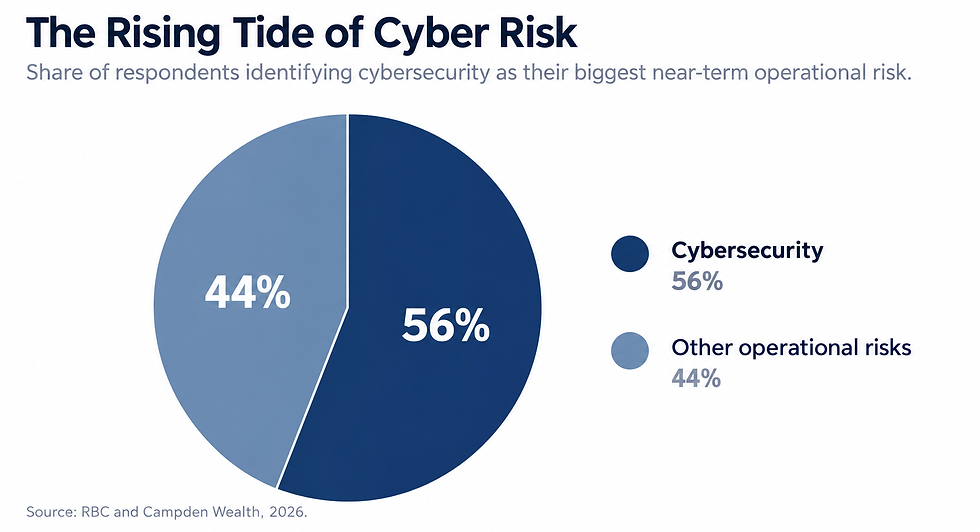
Yet many offices still rely on ad-hoc IT support and personal devices. A single lapse in that setup can expose assets built over generations, and attackers adapt faster than informal defences can.
A real-world warning
In 2024, a finance employee at engineering firm Arup's Hong Kong office joined a video call with what appeared to be the company's CFO and several colleagues. Every other participant was a deepfake. The employee made a series of transfers totalling around US$25 million before the fraud was discovered.
Family offices face the same risk. A cloned voice of a principal requesting an urgent transfer can bypass any control that relies on recognising someone. The defence is process, not instinct: every payment instruction is verified through a second, pre-agreed channel.
The UK regulatory picture
For UK family offices, cybersecurity is a compliance question as well as a security one. Three sets of rules matter most.
Framework | Who it applies to | What it requires |
UK GDPR and the Data Protection Act 2018 | Family office processing personal or financial data | Appropriate security measures; reportable breaches notified to the ICO within 72 hours where feasible; weak security can lead to enforcement action |
FCA-authorised firms in scope of the regime, such as enhanced-scope SM&CR firms | Identify important business services, set impact tolerances and prove recovery from disruption, including cyber incidents | |
All FCA-authorised firms, including multi-family offices and wealth managers | Maintain effective systems and controls to manage operational risk, including cyber risk |
Even single family offices outside FCA scope deal with banks, custodians and advisers who expect evidence of institutional-grade controls. Strong governance makes those relationships easier to maintain.
Establishing rigorous governance
Institutional cybersecurity starts with clear ownership. Someone must be accountable for security decisions, and every staff member should know their role in protecting data.
Key pillars of governance include:
Written security policies covering devices, data handling and incident response
Multi-factor authentication on every account and device
Access based on least privilege, reviewed when roles change
Regular independent audits to find vulnerabilities before attackers do
Managing technology, people and third-party risk
Every new cloud service, personal device and app widens the attack surface. Bringing infrastructure under one managed approach restores visibility and closes the gaps that legacy hardware and fragmented software leave behind.
People need the same attention. Family members and staff are frequent spear-phishing targets because they can authorise payments and access private data. Ongoing awareness training, encrypted communication and strict call-back rules for wire transfers turn them into an active line of defence. That protection should extend to home networks and to what family members share on social media.
Risk also sits with your partners. Custodians, advisers and outsourced IT providers all touch your data, so their security deserves regular review.
Planning for the day something goes wrong
No defence is perfect, so recovery matters as much as prevention. Secure, tested backups and a rehearsed incident response plan mean a breach becomes a disruption rather than a disaster. They also give you the evidence regulators and banking partners expect to see.
Securing your digital legacy
A family's wealth deserves the same protection as any institution's. Clear governance, strict access controls, verified payment processes and resilient infrastructure together lower a family office's risk profile and support its regulatory obligations.
Alternit One works with family offices and financial services firms to build that foundation. Speak to our team to assess your current security posture and plan your next steps.