What should financial firms be monitoring for cybersecurity?

A single missed alert can cost a financial firm far more than money. Client trust, regulatory standing and years of reputation can all take a hit in one afternoon. Meanwhile, attackers keep changing tactics, and many IT teams are already stretched thin.
For most firms, the real problem is not a lack of tools. It is a lack of clear, continuous visibility across everything that matters. At Alternit One, we work with financial services organisations across the UK to keep their systems secure, supported and compliant.
In this blog, we break down the key areas your firm should be monitoring, from endpoints to the cloud. Read on to see where the gaps in your cybersecurity might be hiding.
Why visibility can't wait
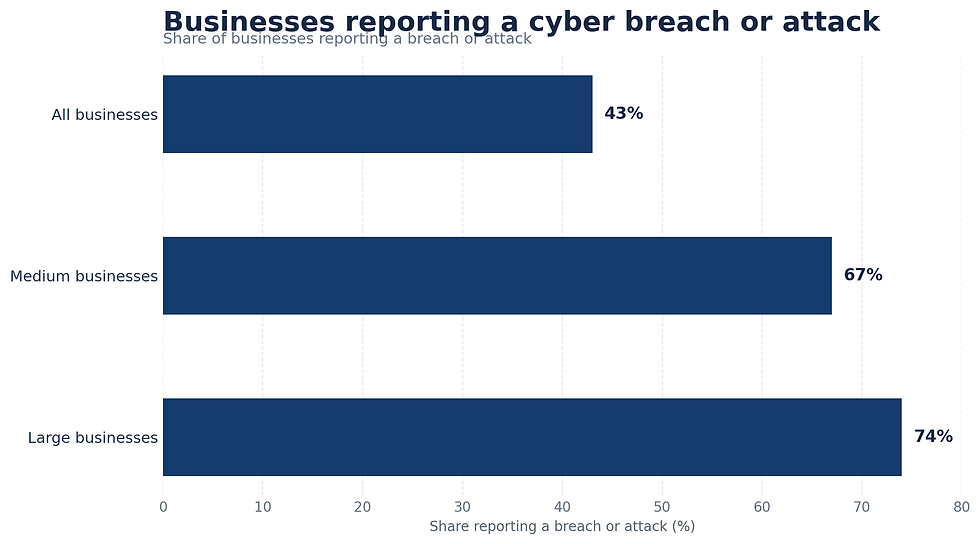
According to the UK Government's Cyber Security Breaches Survey 2025, 43% of UK businesses reported a breach or attack in the previous 12 months. The figure rises sharply with company size, which matters for mid-sized and larger financial firms.
Graph: UK businesses reporting a breach or attack (last 12 months)
The financial cost is just as striking. Based on IBM's Cost of a Data Breach Report 2024, the average breach in the financial sector cost $6.08 million. That is well above the global average of $4.88 million. In short, the earlier you spot a threat, the less damage it can do.
Endpoints are your front door
Every laptop, desktop and mobile device is a possible way in. This is especially true with hybrid working, where staff connect from home, on trains and in cafés.
Key things to monitor include:
Unusual processes or unexpected software installs
Antivirus or endpoint detection agents that have been switched off
Missing patches and outdated operating systems
USB activity and large or unusual file transfers
Endpoint detection and response (EDR) tools help here. However, they only add value when someone reviews the alerts and acts on them quickly.
Your network tells a story
Your network holds valuable clues, provided you know how to read them. Unusual traffic often signals an attacker moving quietly between systems.
Watch closely for:
Spikes in outbound data, which may point to data theft
Connections to known malicious IP addresses or domains
Lateral movement between servers that rarely communicate
Unknown devices joining the network
Firewall and DNS logs are a good starting point. Even so, logs only help when you collect them centrally and review them in context.
Identities are the new perimeter
Attackers often log in rather than break in. Stolen or weak credentials give them the same access as a genuine employee, which makes them much harder to spot.
Look out for:
Logins from unusual locations or at odd hours
Repeated failed login attempts
MFA fatigue, where users receive a flood of approval prompts
Changes to privileged accounts or new admin rights
It also pays to review access rights regularly. Leavers and role changes often leave behind forgotten permissions that attackers can exploit.
Cloud settings need constant checks
Most financial firms now rely on Microsoft 365, Azure, AWS or a mix of platforms. The cloud offers real flexibility, but one misconfiguration can expose sensitive client data.
Keep an eye on:
Storage or file shares open to the public
Changes to security policies and conditional access rules
New third-party app permissions or unusual API activity
Mailbox rules that forward email to outside addresses
Remember the shared responsibility model. Your provider secures the platform, but your data and settings remain your responsibility.
Vulnerabilities don't wait
New vulnerabilities appear every week, and attackers move fast. According to Verizon's 2025 Data Breach Investigations Report, exploiting vulnerabilities was the initial access route in 20% of breaches. That marked a 34% rise on the previous year.
To stay ahead, track:
Regular vulnerability scans across all assets
Patch status for operating systems and key applications
End-of-life software that no longer receives updates
Supplier and third-party systems connected to yours
Prioritise fixes by risk rather than volume. A critical flaw on an internet-facing server should come before a minor issue on an isolated machine.
Turn visibility into action
Monitoring works best when every part joins up. That is where Alternit One comes in, with services shaped around the needs of regulated firms.
Service | How it helps |
Cybersecurity | Monitors threats across endpoints, networks, identities and cloud, then helps you detect and respond quickly |
Managed IT & Support | Keeps devices patched, managed and running smoothly, with responsive day-to-day support |
Compliance & Resilience | Helps you meet regulatory expectations and prepare for disruption through backup, recovery and continuity planning |
Together, these services give your team one clear view of risk. Just as importantly, you gain a partner who can act on it.
Build a more resilient cybersecurity strategy
Cybersecurity in financial services requires continuous visibility, monitoring and coordination across the entire environment, not just an annual audit.
Alternit One helps financial firms strengthen security, respond to threats faster and support ongoing compliance without adding unnecessary pressure to internal teams.
Ready to strengthen your cybersecurity? Explore how Alternit One can help protect your environment with proactive cybersecurity and managed IT services. Talk to Alternit One


